
← Back to Research & Publications
Ouadi Hammamat
Quarries, inscriptions and memory of the Eastern Desert.

The Wadi Hammamat and the god Min
Desert sanctuary and place of royal emergence
The quarries of Ouadi Hammamat are not only a space of extraction and passage. Several clues converge to show that this was a place with a strong religious dimension, closely linked to the god Min.
Min, deity of the Eastern Desert, fertility, and generative power, is also associated with mining expeditions and the assertion of royal power beyond the Nile Valley. His great center of worship was at Coptos, traditional starting point for expeditions to Ouadi Hammamat. This geographical and cultural continuity suggests a structuring religious anchoring.
Expedition inscriptions show that extractive activity was placed under divine protection. The desert was not a neutral space: it came under sacred jurisdiction. Working the stone, extracting it, transporting it, implied placing human action in a cosmic order guaranteed by divinity.
A meeting place between earthly and divine royalty
In several inscriptions, the king appears as the organizer of the expedition and guarantor of technical efficiency, but also as a mediator between the human world and the divine sphere.
Ouadi Hammamat thus becomes a liminal space:
- border between cultivated valley and desert;
- a threshold between human territory and the divine realm;
- place where royalty asserts its legitimacy outside the Nile valley.
The act of inscribing one's name in the rock is not just an administrative matter. It is part of a gesture of symbolic and ritual appropriation. The stone becomes a medium of memory, but also the surface of contact between royal power and divine order.
The divine “nest” of Horus and the symbolic birth of royalty

Horus, the quintessential figure of living royalty, embodies the celestial sovereignty and divine origin of the king.
If the Ouadi Hammamat is envisaged as a primitive sanctuary of Min and a space of symbolic inauguration, it can be understood as a “nest” of kingship — a place of emergence where divine power is anchored in the desert stone.
The greywacke (“bekhen”), extracted from these quarries, was used to produce statues and related prestige objects to the royal representation. The very material of power therefore came from this sacred desert space.
The site therefore appears as:
- a place of material extraction;
- a place of memorial inscription;
- a place of symbolic activation of royalty.
Thus, far from being a simple desert corridor, the Ouadi Hammamat appears as a structured space both by political, religious and economic issues. It is in this articulation that its history is written.
Ouadi Hammamat
Quarries, inscriptions and memory of the Eastern Desert
A strategic corridor
Located in the Egyptian Eastern Desert, the Wadi Hammamat connects the Nile Valley to the Red Sea.
For millennia, this desert corridor was both:
- a major circulation route,
- a stone-extraction area,
- a territory administered and invested symbolically, placed under divine protection.
The site is particularly known for the exploitation of stone known as “bekhen” (greywacke), used for statues and prestigious objects since ancient times.
The desert is not peripheral: it is structured, traversed, organized.
A written landscape

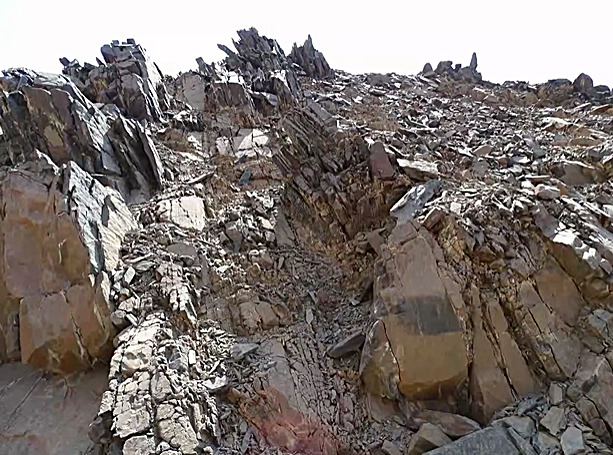
Ouadi Hammamat is distinguished by an exceptional concentration of inscriptions engraved on the rock walls.
There we find:
- inscriptions from royal expeditions,
- team signings,
- administrative mentions,
- engraved figures,
- even older marks.
These texts document the organization of careers, hierarchies, logistics and religious practices linked to the desert. The stone thus preserves a direct memory of human action.
The corpus was gradually enriched by several survey and prospecting campaigns, particularly in the twentieth century.
A mapped memory
The site is also associated with the Turin Papyrus, often presented as the oldest preserved geological map.
This document is linked to an expedition during the reign of Ramesses IV. It represents a section of the Ouadi Hammamat, indicating reliefs and rock formations.
Modern analyses have shown the consistency between this map and the site's actual geography, testifying to precise technical knowledge of the terrain.
My work on the Ouadi Hammamat
Read the desert
Working at Ouadi Hammamat means entering a landscape where the stone preserves the memory of men and invoked powers.
I am co-leading an epigraphic mission dedicated to this site with Dr Annie Gasse (CNRS) and Dr Vincent Morel (Yale University), aiming to document, analyze and publish the inscriptions engraved in the quarries of Ouadi Hammamat.
My research focused in particular on the reinterpretation of all the quarries of Ouadi Hammamat as the primitive sanctuary of Min.
This work is not just about reading texts. It’s about understanding:
- why an inscription was engraved in a specific place;
- how it fits into the career space;
- what was its visibility;
- and what it reveals about the organization of the expeditions.
A method rooted in the field
My approach is based on direct and meticulous observation of the rock walls.
Each inscription is studied with attention to:
- geological support;
- engraving techniques;
- surrounding topography;
- and possible interactions between engraving and painting.
I consider that the text cannot be dissociated from its materiality.
At Ouadi Hammamat, the landscape is not just a decoration: it is an integral part of the message.
Chromatic discoveries (2021)

In 2021, I co-signed the article with Vincent Morel:
“Chromatic discoveries in the quarries of Ouadi Hammamat” (Bulletin of the French Society of Egyptology, n°205).
During our observations, we identified traces of color preserved on certain inscriptions.
The study identified 26 cases of chromatic use (dipinti and painted engravings), covering periods from the Old Kingdom to the Roman era. These elements lead us to reconsider several aspects:
- some inscriptions were probably painted or enhanced;
- the current appearance of the site — dominated by bare stone — does not necessarily reflect its ancient state;
- the visual and chromatic dimension must be integrated into the analysis.
In a space invested with strong religious and royal significance, color probably contributed to visibility and the symbolic activation of inscriptions.
Studying Ouadi Hammamat therefore means restoring the text's material and visual dimensions, and placing each inscription back into the space that gives it meaning.
Toward publication of the corpus
This fieldwork is part of a broader perspective: the critical edition and scholarly publication of the corpus of inscriptions from Ouadi Hammamat.
The aim is to provide precise, contextualized and sustainable documentation, in order to make this inscribed landscape fully accessible to research.
Publications related to Ouadi Hammamat
Article
Morel, Vincent & Olette-Pelletier, Jean-Guillaume.
“Chromatic discoveries in the quarries of Ouadi Hammamat”.
Bulletin of the French Society of Egyptology, n°205, 2021.
DOI :
10.3917/bsfe.205.0016
.
Online version available on
Academia
.
Additional scientific resources
Wadi Hammamat Project
Multidisciplinary archaeological project dedicated to the quarries and landscape of Ouadi Hammamat. The site presents scientific objectives, field reports and publications relating to the study of the site.
Multidisciplinary archaeological project dedicated to the quarries and landscape of Ouadi Hammamat. The site presents scientific objectives, field reports and publications relating to the study of the site.
Conferences & public interventions

Conference
“Discovery of unpublished pharaonic texts in the heart of Ouadi Hammamat”
Catholic Institute of Paris, "Art Thursdays" series, October 13, 2022
See the recording of the conference of October 16, 2022
I had the pleasure of speaking during the Art Thursdays series, organized by the Catholic Institute of Paris. For the 2022-2023 season, Art Thursdays explored the theme of "buried heritage."
I presented unpublished pharaonic texts identified at Ouadi Hammamat, placing them in their archaeological and historical context in order to clarify their administrative and symbolic dimensions.