
Understanding ancient Egypt through the stone itself
An inscription carved in the Eastern Desert.
A divine name traced almost four millennia ago.
A formula whose arrangement reveals a logic.
Egyptian religion is not understood only through narratives: it is built in writing, in stone, and in monuments. This materiality is where my investigation begins.
My work analyzes Egyptian religious thought through inscriptional forms: votive and funerary stelae, monumental texts, hieroglyphic traditions, and cryptographic devices.
Writing is not a simple support; it actively shapes the divine.
Academic background
Trained in History at the Institut Catholique de Toulouse (BA, 2007), I specialized in Egyptology at Paris-Sorbonne University (Paris IV).
Master 1 (2010–2011), Honors
Circular religious constructions in ancient Egypt
(supervisor: Dominique Valbelle)
Master 2 (2011–2012), High Honors
The sehenet chapel of the god Min: typology and lexicography
(supervisor: Dominique Valbelle)
PhD in Egyptology (2013–2017)
under the supervision of Pierre Tallet.
Thesis defended on November 23, 2017:
Min, the "mighty of the gods": the god Min, from the First Intermediate Period to the end of the Second Intermediate Period.
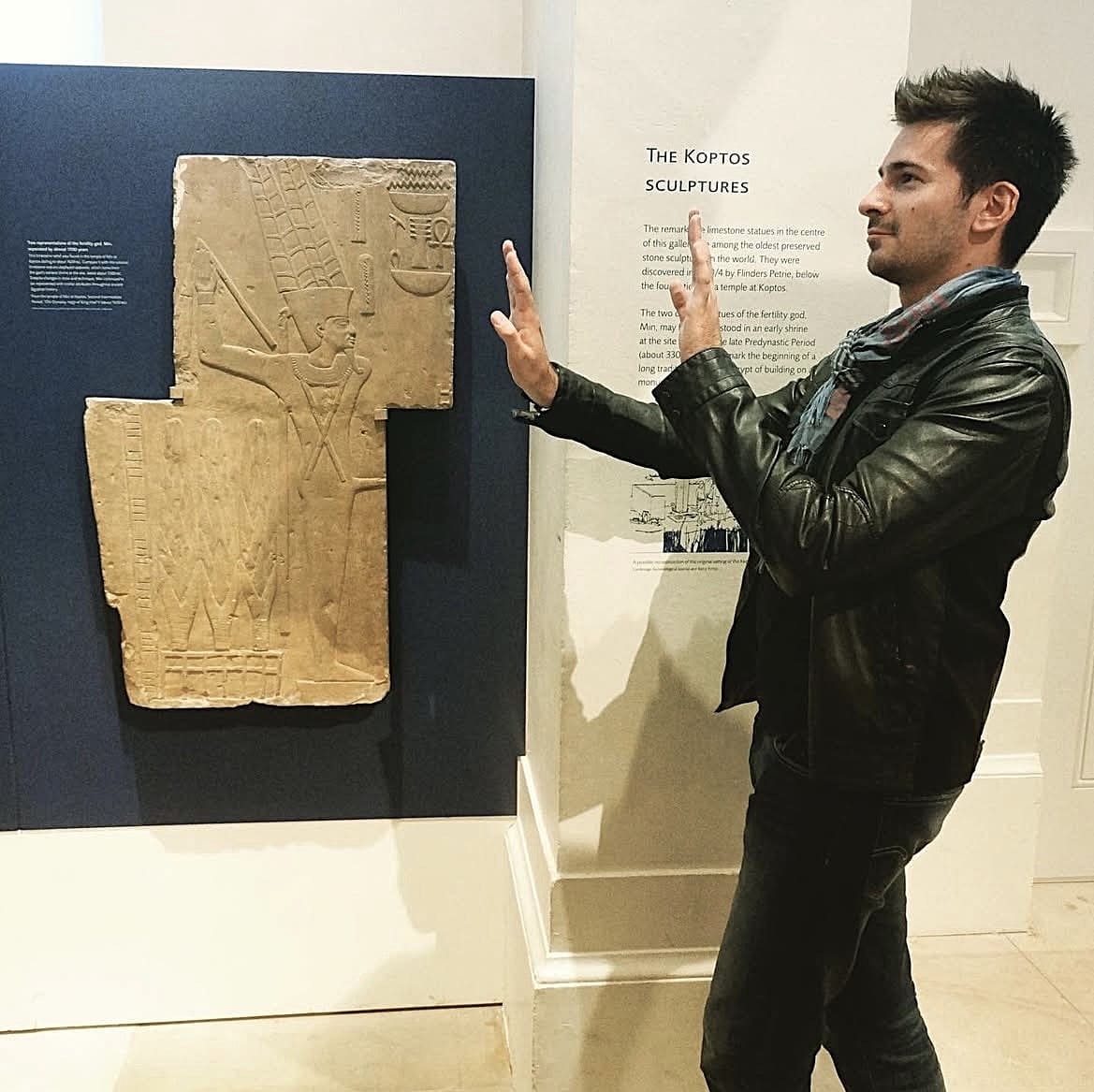
Min is one of the oldest deities in the Egyptian pantheon. His cult is attested from the Old Kingdom onward and experienced significant development in Upper Egypt, notably at Coptos and Akhmim. He is mainly associated with fertility, generative power, and regeneration. In pharaonic iconography, he appears in anthropomorphic form, holding a flail, and may display imagery explicitly linked to fecundity, emphasizing his role as a vital force.
This research offers a historical and philological study of the god Min in the 2nd millennium BCE, based on a cross-analysis of textual, monumental, and archaeological sources. It highlights the regional and political transformations of a major divine figure between the First Intermediate Period and the end of the Second Intermediate Period.
Distinctions
- 2014 – Fellowship holder at the Institut français d’archéologie orientale (IFAO)
- 2016 – Fellowship holder at Paris-Sorbonne University (doctoral mission abroad program)
Additional training in communication (BA, European Communication School, 2008-2011, jury honors) complements this path and supports an ongoing commitment to sharing scholarly knowledge.
Research areas
My research is structured around closely connected fields:
- Ancient Egyptian religion
- The god Min and his historical developments
- Votive and funerary stelae from the Middle Kingdom and the Second Intermediate Period
- The sanctuaries and necropolises of Coptos and Abydos
- Epigraphy, prosopography, and genealogy (late 3rd–2nd millennium BCE)
- Paleography of the Third Intermediate Period
- Hieroglyphic cryptography
The objective is to restore the internal coherence of Egyptian religious thought by situating it within its material, social, and political frameworks.
Fieldwork as method
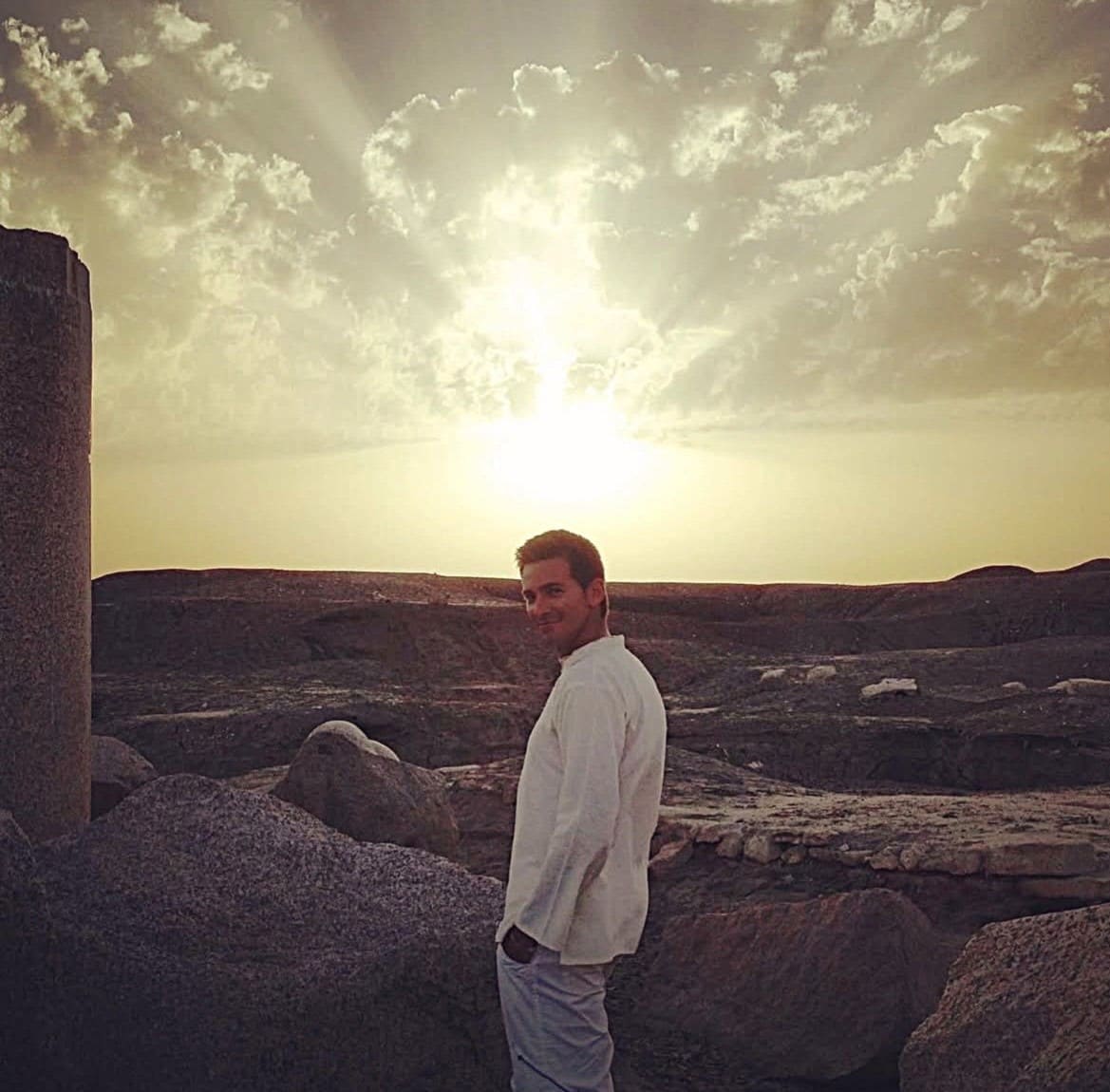
Fieldwork lies at the core of my scientific approach.
I regularly work as an epigraphist in Egypt, contributing to the study and documentation of monumental and rock inscriptions.
Scientific participation:
- Epigraphic mission of Karnak (Franco-Egyptian Center for the Study of the Temples of Karnak – CFEETK)
- Epigraphic mission of Tanis, Sân el-Hagar (French Excavation Mission of Tanis – MFFT)
- Digitization of the archives of the French Excavation Mission of Tanis at the École pratique des hautes études (EPHE)
Since 2015:
- Member of the epigraphic mission of Tanis
- Member of the Hieratic Academy of the Institut français d’archéologie orientale (IFAO, Cairo)
- Member of the epigraphic mission of Karnak
Since 2014:
- Head of the digitization of the archives of the French Excavation Mission of Tanis (EPHE)
Currently:
Co-director of the epigraphic mission at Ouadi Hammamat with Dr Annie Gasse (CNRS) and Dr Vincent Morel (Yale University), a scientific program dedicated to the study, documentation, and analysis of rock inscriptions and pharaonic quarries in Egypt’s Eastern Desert.
This mission documents the epigraphic corpora of Ouadi Hammamat, analyzes their historical and religious contexts, and places them within the political, economic, and cultic networks of ancient Egypt.
Teaching and outreach
I teach history and art history of Pharaonic Egypt at the Catholic Institute of Paris, and since 2014 I have also taught Egyptology courses for the association "L’Égyptien de Bois d’Arcy".
I am also:
- Associate member of the Mondes pharaoniques laboratory, a research team affiliated with Sorbonne University (Joint Research Unit 8167 "Orient & Méditerranée"), dedicated to the study of the history, texts, and cultures of ancient Egypt and the Near East
- President of the Cercle Pétrarque , a cultural association dedicated to spreading knowledge about ancient civilizations and fostering dialogue between academic research and a broader informed public.
Conferences, teaching, and collective projects extend scientific research into spaces of dialogue and knowledge sharing.
Grounded and open research
Studying ancient Egypt means accepting that religious thought is neither abstract nor fixed: it is inscribed, materialized, and transformed by history.
It is from this materiality that I work, combining philological rigor, field engagement, and a commitment to transmission.
Understand the signs.
Understand the gods.
Understand the logic that connects them.